
Stop the Tour
What did the 1981 Springbok protests really reveal about New Zealand?

This is a stand-alone essay that also constitutes part 12 of a chronological essay series on New Zealand culture.
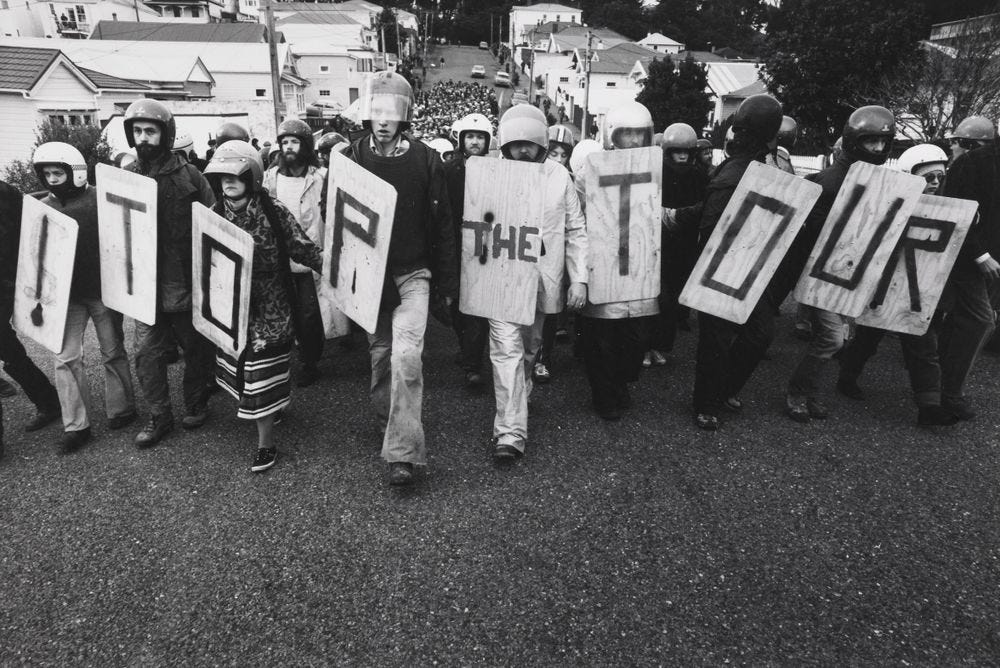
In 1981, a fight over rugby almost brought New Zealand to the point of civil war. When South Africa’s whites-only Springbok team travelled here for a 56-day tour, over 150,000 people across 28 New Zealand centres protested. Police used batons for the first time in decades — the strategy was to advance toward protestors in formation while thrusting the batons forward, chanting “oo-oo.” If protestors didn’t retreat they were beaten back. Many wore helmets; some sustained head injuries or permanent injuries. Police arrested over two thousand people nationwide. Merata Mita’s documentary Patu! (1983) shows the activists who stormed Hamilton’s rugby pitch chanting at police: “The whole world’s watching. The whole world’s watching.”
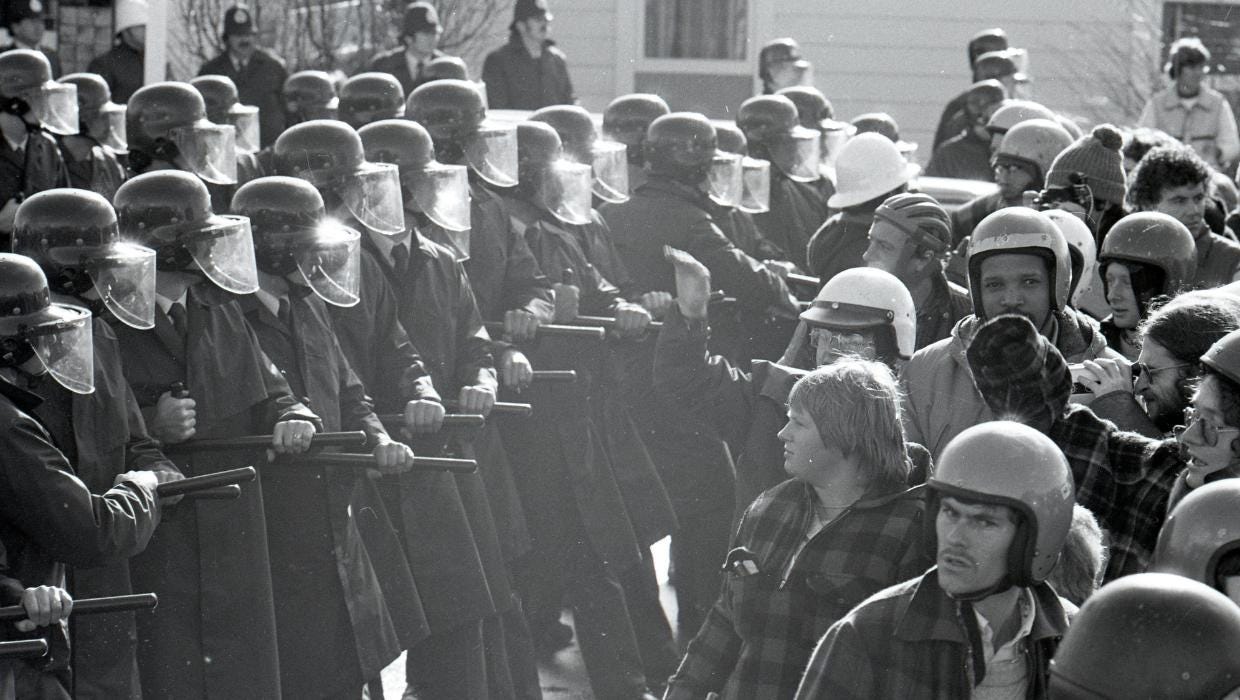
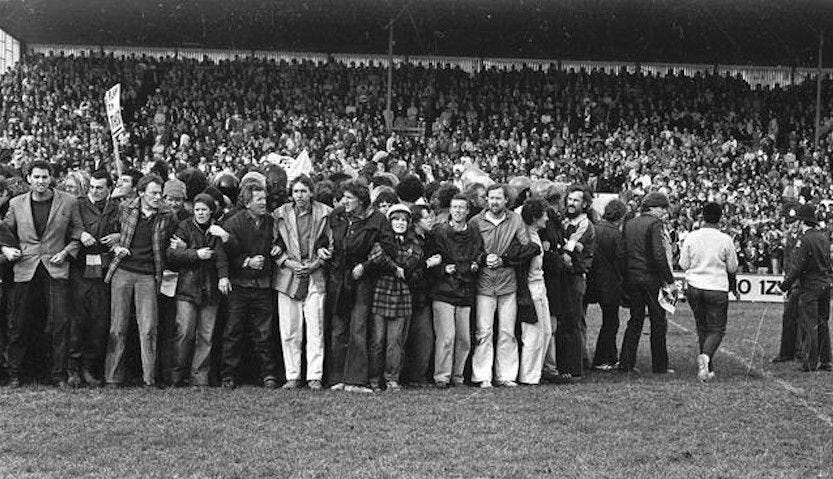
The Springbok protests hold an important place in New Zealand’s national psyche. They tend to be remembered as an expression of conscience on the part of everyday Kiwis and evidence that, though New Zealanders are laid back, we have principles and will stand up for them. When things get bad enough, we act.
This narrative overlooks three important things. One: the 1981 Springbok protests took place in a context of domestic racism. Activists began objecting to rugby against the Springboks in the early twentieth century when Māori players were stood down from All Black tours to South Africa. The first instances were 1919 and 1928. The Māori Women’s Welfare League opposed rugby with South Africa from 1954, shortly after the League’s formation. Nga Tamatoa also called for the severing of sporting ties with apartheid South Africa, especially via the rugby association, from the mid-twentieth century.
Two: large-scale anti-apartheid sports boycotts were ultimately of South African, not New Zealand, origin. Today we are familiar with global Boycotts, Divestments and Sanctions (BDS) movements, but South Africa’s anti-apartheid activists created the original BDS campaign. Throughout the 1960s, the Anti-Apartheid Movement (AAM) built contacts and campaigned for sanctions and boycotts, including sports boycotts, worldwide.
Three: New Zealand, like South Africa, is a rugby nation. Rugby has the status of a religion here, and protestors were more than matched by a government and culture determined to “keep politics out of sport” and fight — violently — for rugby spectatorship as a basic human right. The government spent almost eight million dollars to ensure the rugby would proceed, and enlisted support from the army. Two games were cancelled. Fourteen were played.
New Zealand’s Rugby Union was founded in 1892 and by the early twentieth century, rugby was the national sport. From the beginning, there was “little reluctance to recognise or accept Māori talent” except during tours of South Africa when Māori players were stood down. In 1960, when the All Black team chosen to tour South Africa was racially selected, protesters declared ‘No Māoris, No Tour’. The Labour government under Walter Nash declined to intervene, “and it was business as usual for the New Zealand Rugby Football Union and most of the rugby-loving public.”
That same decade, South Africa’s global BDS campaign gained traction. Anti-Apartheid Movement activists lobbied the Commonwealth in 1960–61, campaigned for the release of South African political prisoners, and organised the International Conference on Sanctions against South Africa in 1964. In 1962, AAM representative Abdul Minty succeeded in persuading the International Olympic Committee to exclude South Africa from Olympic sport. The ban lasted 1964-1992, and Minty recalls: “There were massive protests subsequently at sports matches in Britain and through public action we put an end to all major rugby, cricket and other tours.”
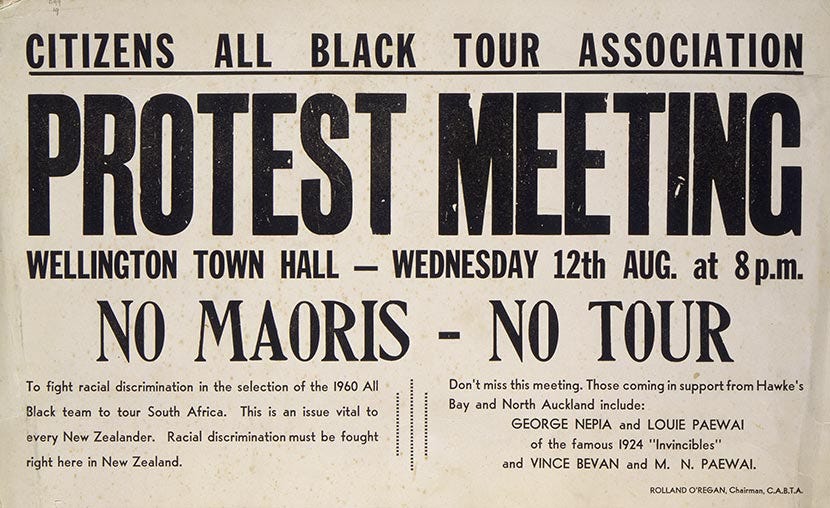
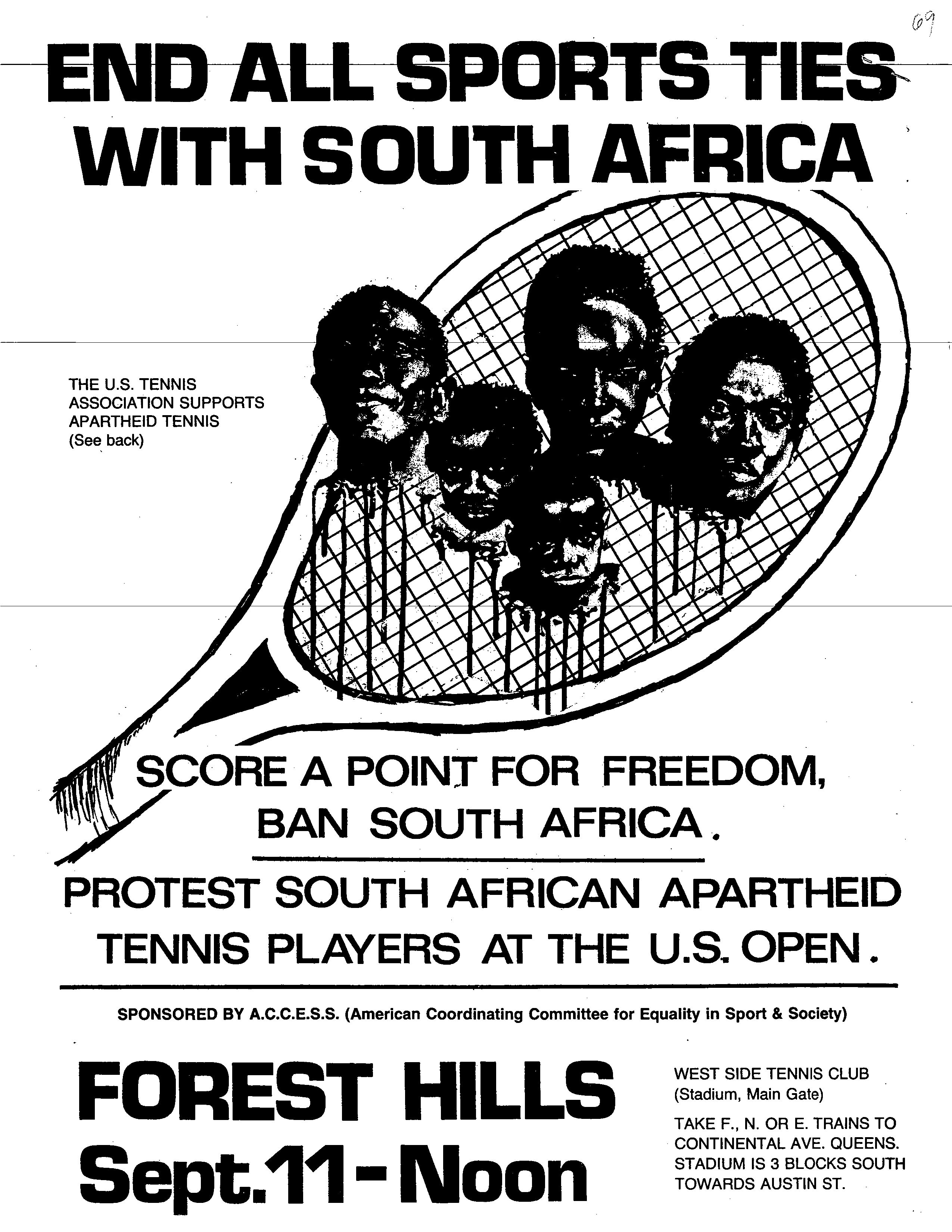
In New Zealand, Trevor Richards and Tom Newnham formed Halt All Racist Tours (HART) in 1969, to protest rugby union tours to and from South Africa. By 1973, the Labour government under Norman Kirk cancelled a Springbok tour of New Zealand after police advised it would “engender the greatest eruption of violence this country has ever known” (a prediction realised in 1981).
In 1976, prime minister Robert Muldoon refused to cancel an All Blacks tour to South Africa. He represented the crowd Tim Shadbolt called the KPOOS: Keep Politics Out of Sport. In A Man’s Country (1987), historian Jock Philips recalls encounters with KPOOSers during Springbok protests:
For myself and the thousands of others who marched in protest the primary focus was a disgust that New Zealand should host representatives of a regime built upon racism. Yet the protest also represented a challenge to the male stereotype. Rugby contests with South Africa had traditionally been peacetime’s sternest tests of the nation’s virility …
As we marched off to our assigned positions … bystanders and intending rugby spectators were quite aware of the affront to male culture represented ... Groups of leering young men would saunter up to us and yell, ‘Whaddaya, a pack of poofters?’ or ‘You’re just a pack of girls’ or even ‘You’re not real Kiwis, are you?’
During one action, Philips’ group sat down to block traffic outside a pub, “that citadel of male culture,” and the police arrived to apprehend HART founder Trevor Richards. Philips continues:
and then some drunken males came out onto the footsteps of the pub, glasses and jugs in hand, to shout their abuse at us and question our sexuality, our legitimacy and our patriotism … Suddenly glasses were raining down from the balcony of the pub and then jugs followed. The inevitable happened – a man staggered to the footpath bleeding profusely from the head. Others were cut less severely. There were no instant heroes among our nervous and shaken band of protestors and sensibly we retreated from the onslaught. We had more than enough of our confrontation with young Kiwi males.
Philips adds that “the moral judgement here is not all one way. While the Springbok tour protesters represented a challenge to traditional male values, the break was never complete.” His recollections suggest protestors wanting to ‘win’ against the baton-clad police almost in the manner of a rugby match. Wellington’s anti-tour organisation ran practice sessions in a community hall where activists rehearsed marching in line. At one point, the organiser unthinkingly ordered the group to “Stand at ease”:
He caught himself, sheepishly self-conscious about what he had said. We were back with platoons and barking sergeants and cadets on Friday afternoons.
The practice did not end there. We were now taught how to resist arrest. The order came out to form ourselves into a wedge with strong men on the outside, women and smaller men in the middle … Then we were asked to link arms and with head down and legs braced prepared to meet the ‘police’ foe. The ‘police’ arrived, we struggled and pushed, and eventually broke, hot and sweaty. Once more subliminal memories came to the fore. It was scrum practice on Thursday afternoons with ‘Killer Smith’ standing there yelling, ‘Bind. Get your hands down. Whaddaya some kind of pansy?’
The ironies multiplied, and I began to wonder whether the journey from 1956 to 1981 represented quite the revolution that I had expected.
The films Patu! and Uproar (2023, starring Julian Dennison and Minnie Driver) capture racial tensions during and within the protests. Many white activists were unaware of the depth and pervasiveness of domestic racism. HART leader John Minto discovered while leafletting: “There’s a big section of New Zealand that is racist to the core … you’ve only got to touch the surface lightly and boy, it just wells up.” Many Pakeha had their first experiences of police brutality in 1981 and were shocked when Māori and Pasifika tried to inform them that state violence was an everyday reality for them. One Māori activist in Patu! pleaded: “What I’m really wanting to say to you is: okay, you fight that thing in South Africa. But remember it happens here too.”
Canon Hone Kaa reflected: “The anti-apartheid movement of New Zealand had mobilised itself to fight racism in South Africa. It had now to begin to search its own soul about, where had it been, where was it going and what tactics should it use to now face the issue of racism at home.”
Most of the 1500 protestors arrested received fines or diversion; some were issued prison sentences of several weeks or months. Hone Harawira of Nga Tamatoa, and Polynesian Panthers founder Will ‘llolahia endured a two-year trial along with nine others. They had organised the Patu Squad to take on the Red Squad (the militarised riot-control unit of the New Zealand Police) at Auckland’s Eden Park. ’Llolahia faced up to ten years in prison.
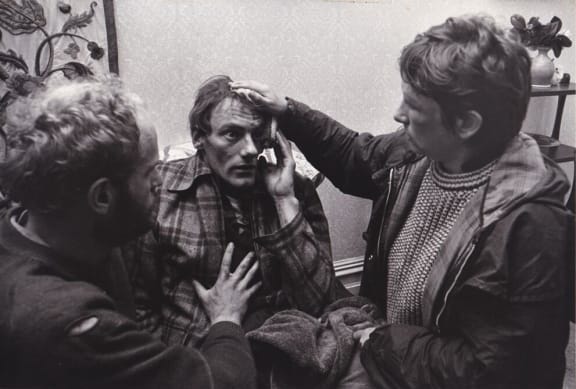
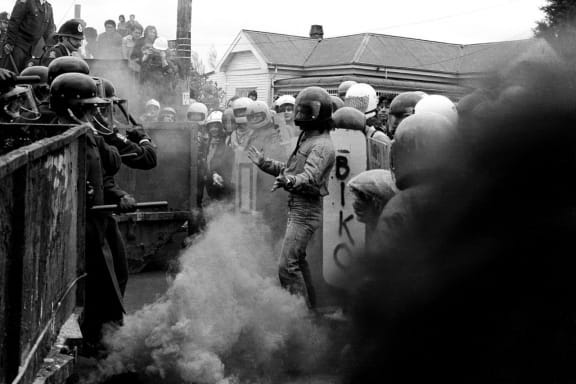
“We had the top fighters from all the street gangs,” he remembers. “In the court case, they said [out of] 36 members of the Red Squad that we fought with … after the battle, 24 [were] permanently injured. They couldn’t work anymore.” Polynesian Panther and Patu Squad member Tigilau Ness explains: “It wasn’t just a venting of frustration and anger ... There was a reason for it. Apartheid was the beast that we have to slay.” Ness served perhaps the longest sentence: nine months at Mount Eden prison for rioting and unlawful assembly.
’Llolahia and Harawira were spared prison when HART flew archbishop Desmond Tutu over from South Africa to appear as a witness for the trial. Tutu acknowledged the defendants as humanitarians. ’Llolahia recalled that it took the jury seventy minutes “to come out and find us not guilty.” That wasn’t the end of the story, though:
When I was walking out of the trial, the cops … [from] the Red Squad … they said, “We’ll get you fucken ’Llolahia.” …
I’ve clashed with these guys from the Panther days. They were in the Task Force, Bastion Point … And then with Patu Squad … they were just getting tired of me getting off all the time. So I felt I was going to either get hurt or get done for something … So I split off and went to Tonga.
This spelled the end of the Polynesian Panthers — but not the influence of Pacific activism in New Zealand. The Nuclear-Free and Independent Pacific movement was already coaxing New Zealand’s government to put aside concerns about its military and political ties to the United States and join the call for a nuclear-free Pacific. That’s the topic of the next essay.